
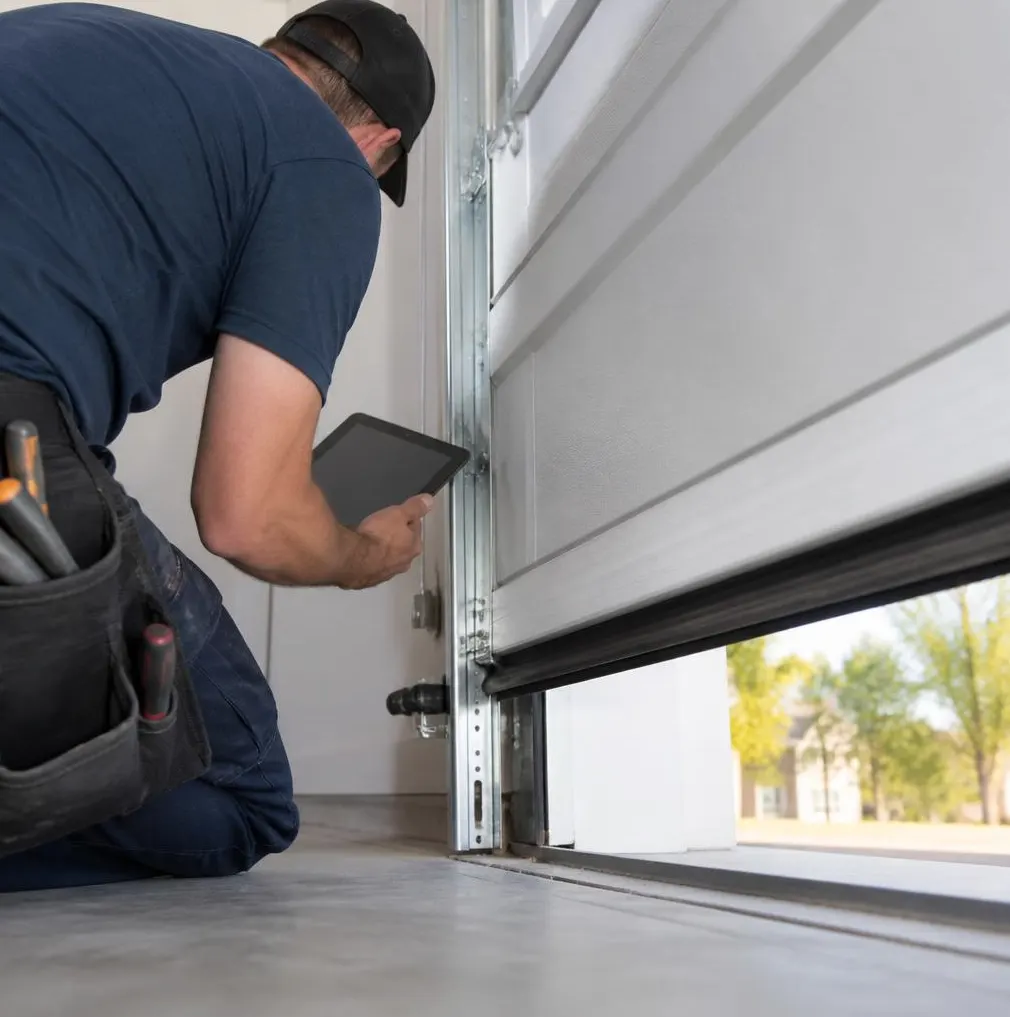
Short answer: if your garage is attached to the house, or you spend real time out there, insulation is worth it. If it's a detached, unheated garage you only use to park and grab the trash cans, you're probably paying extra for a number that won't change your life. Here's the reasoning, so you can both stop arguing and actually make the call.
What R-value is actually measuring
R-value measures how well a material resists heat flow. A higher number means less heat moves through the door. Garage doors are commonly rated somewhere in the range of R-6 to R-18 depending on construction — single-layer steel with no insulation sits near zero, while a double-layer steel door with polyurethane foam core can hit the higher end of that range.
But R-value on the label is tested under lab conditions with the door sealed perfectly. Your actual garage door has hinges, a bottom seal, side seals, and usually a gap or two that no R-value rating accounts for. That's the part people on both sides of this argument tend to forget.
Who genuinely benefits
- Attached garages. If your garage shares a wall with living space, an uninsulated door is a direct pipeline for cold air into that wall and anything above it. Insulation here isn't cosmetic — it reduces how hard your furnace works and keeps the adjacent room from feeling like a cold spot all winter.
- Garages used as workspace. If someone's out there running a workbench, a home gym, or parking a second fridge, insulation plus a sealed door makes a measurable difference in comfort, especially once overnight temperatures swing hard, which they do here through fall and winter.
- Homes with an opener-sensitive setup. Openers, sensors, and belt-drive mechanisms don't love big temperature swings. An insulated door keeps the garage closer to a stable temperature range, which is gentler on the hardware over years of use.
- Anyone bothered by noise. Insulated doors are almost always heavier and have a sandwich construction that dampens sound — less boom when it opens and closes, less drum-like resonance in wind.
Who's paying for nothing
- Detached, unheated garages used purely for parking and storage. If there's no shared wall with the house and no one spends time in there, the insulated door mostly just protects the car and whatever's stored inside from extreme swings — nice, but not something you'll feel as a utility bill difference.
- Anyone whose real problem is sealing, not insulation. A high-R door with a worn-out bottom seal, gapped weatherstripping, or a warped panel will underperform a cheaper door that's properly sealed. If your current door lets daylight in around the edges, that's the fix-it-first issue — buying a higher R-value door without addressing the gaps is money spent on the wrong problem.
The factors that matter more than the R-value number
Dry air and big day-to-night temperature swings mean garage door materials expand and contract more here than in milder climates. That movement is what causes seals to shrink, gaps to open, and weatherstripping to crack over time — all of which quietly erase whatever insulation value you paid for. A door with a solid R-value and bad seals performs worse than a modestly insulated door that's sealed tight.
Also worth knowing: hail is a real factor for summer storms here, and double-layer steel insulated doors generally hold up to hail and dents better than thin single-layer steel, simply because there's more material and structure. That's a separate argument from thermal performance, but it's often the thing that actually tips a close decision.
When to call Millcreek Garage Door Experts
If you're trying to figure out whether your current door's seals are the real problem, or you're ready to compare insulated options for an attached garage, that's a conversation worth having before you buy anything. We handle Garage Door Installation for homeowners weighing insulated vs. non-insulated doors, and we also do straightforward Garage Door Maintenance visits to replace worn weatherstripping and seals on doors that just need a tune-up, not a replacement. Either way, we'll tell you honestly which one fixes your actual problem.
If you're in Millcreek, UT or anywhere nearby in the Salt Lake Valley and want a straight answer on insulation before winter sets in, call Millcreek Garage Door Experts for a quick assessment and a quote.