
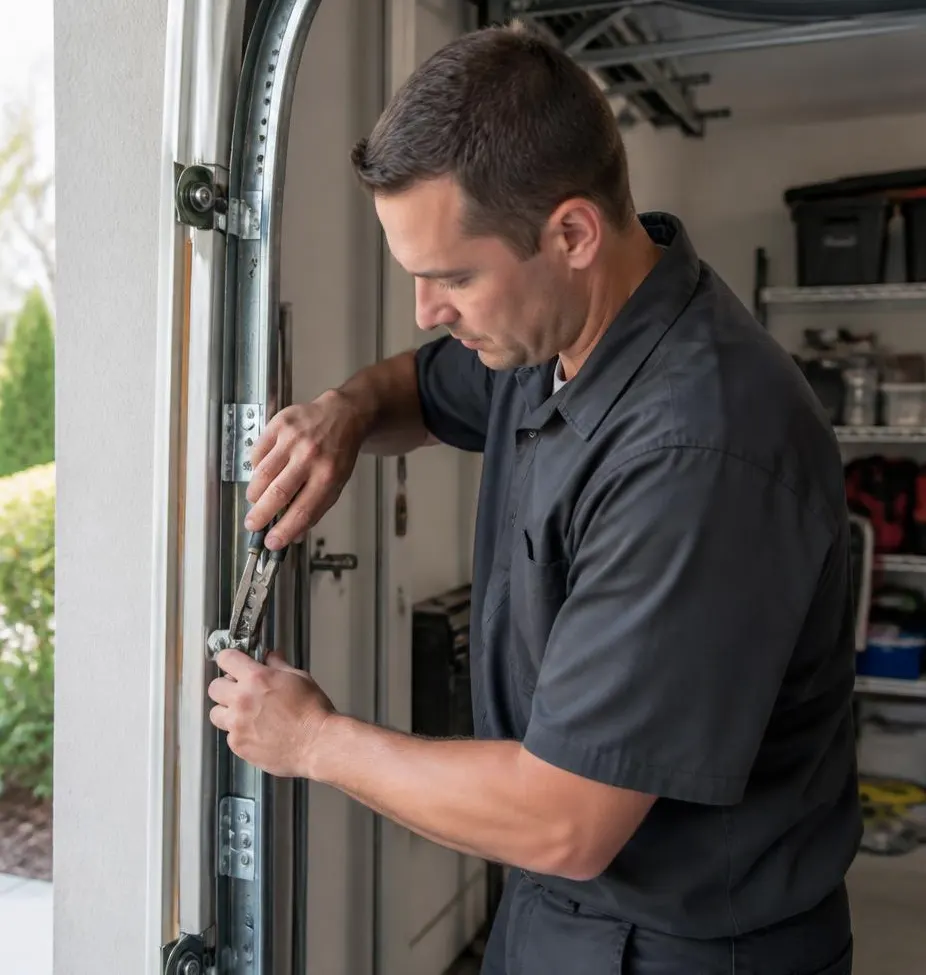
Bent or Misaligned Garage Door Tracks: What's Going On
If your garage door shudders, grinds, or looks crooked as it travels, check the tracks before anything else. The exception is a door that won't move at all, or feels unusually heavy the moment you lift it by hand — that pattern points to a broken spring, not a track problem, and needs a different fix entirely.
The Symptoms That Point to a Track Issue
Track problems rarely announce themselves with a loud bang. They show up gradually, as:
- The door riding higher on one side than the other as it opens or closes
- A grinding or popping sound near the rollers, especially at the same spot every cycle
- A visible gap between a roller and the track it's supposed to sit in
- The door reversing on its own partway through closing
- Daylight showing at one bottom corner even when the door looks fully closed
- A roller that has jumped the track entirely and sits outside the rail
Any one of these is worth a closer look before you run the door again. A door fighting a bent track puts extra load on the opener and the rollers, which turns a small problem into a bigger one fast.
Working Through the Causes, in the Order a Technician Checks Them
1. Loose Brackets and Fasteners
This is the most common cause and the first thing checked, because it's also the easiest fix. Millcreek's big day-night temperature swings mean the metal track and the jamb it's bolted to expand and contract at slightly different rates through the day. Over months and years, that constant tiny movement works lag bolts loose. The fix is straightforward: tighten every bracket, confirm the track is plumb with a level, and re-shim where the jamb has moved slightly out of square. No parts replacement needed, and it's often all the door needed.
2. Impact Damage
A car backing out before the door is fully up, a bike or ladder leaned against the rail, or stored bins pushed too close — any of these can kink a track just enough to catch a roller. A technician checks by sighting down the length of the track or holding a straightedge against it. A light bend can sometimes be worked back into shape with locking pliers and a mallet. A crease where the metal has actually cracked or folded means replacing that section rather than bending it back, since a repaired crease tends to fail again under load.
3. Snow, Ice, and Debris Buildup
This one is seasonal and very local to how Millcreek winters work. Snowmelt that refreezes overnight, thanks to those sharp day-night temperature drops, can form ice right in the bottom of the track or on the rollers themselves. A roller riding on ice tends to jump the track rather than bend it, but repeated jumping stresses the track flange and can gradually splay it open. Road salt and gravel tracked in on tires does similar damage over a season, grinding rollers slightly out of true. The fix is cleaning the track, checking the flange for spreading, and lubricating with a proper garage door lubricant — not a general-purpose spray, which attracts more grit than it clears.
4. Worn or Damaged Rollers
Rollers that are cracked, flat on one side, or missing bearings don't ride straight, and a roller that doesn't ride straight pushes sideways on the track with every cycle. This shows up as a slow, steady misalignment rather than a sudden one. Replacing worn rollers is the fix, and it's a good moment to upgrade to sealed nylon rollers, which run quieter and put less wear on the track going forward.
5. Track Alignment Issues From Installation or Structural Shift
Sometimes the tracks were never quite parallel from the day the door was installed, and sometimes a garage's framing shifts slightly over years of freeze-thaw cycles in the slab or foundation — not uncommon anywhere in the Salt Lake Valley with the winters this area gets. A technician checks both vertical tracks for plumb and measures the distance between them at several heights to confirm they're equidistant top to bottom. The fix is loosening the brackets, re-shimming to correct the gap, and rechecking the door's full travel before locking everything back down.
6. Severe Bends That Require Replacement
If a track is sharply kinked, cracked, or rusted through, realignment won't hold. Rust is less common here given how dry the air generally is, but it does show up on tracks positioned under a gutter that funnels meltwater onto them every winter. In these cases the right fix is replacing that track section with one that matches the existing gauge and profile, rather than trying to coax a damaged rail back into service.
Why a Bent Track Is Worth Fixing Promptly
A garage door is a heavy, spring-loaded, overhead-moving object, and the track is what keeps that movement predictable. Running a door on a bent or misaligned track stresses the opener motor, can crack panels where the door binds against the frame, and in worse cases lets a roller shoot out or a cable slip off its drum. None of that is something to wait on through a Utah winter, when the door is also doing double duty keeping cold air and blowing snow out of the garage.
When to Call Millcreek Garage Door Experts
If your door is binding, grinding, or visibly crooked as it moves, that's the time to call before running it through another cycle. Our Garage Door Repair service covers track realignment, bracket re-shimming, and roller replacement, and our Garage Door Maintenance visits catch loose brackets and early track wear before they turn into a stuck door on a Tuesday morning. If the door is jammed open or closed on a bent track right now, that's what our Emergency Garage Door Service is for.
Call Millcreek Garage Door Experts for same-day garage door service in Millcreek, UT and across the Salt Lake Valley — we'll find the cause, not just patch the symptom.